Company Name vs Brand vs Product vs Domain Explained
24 Oct, 2026
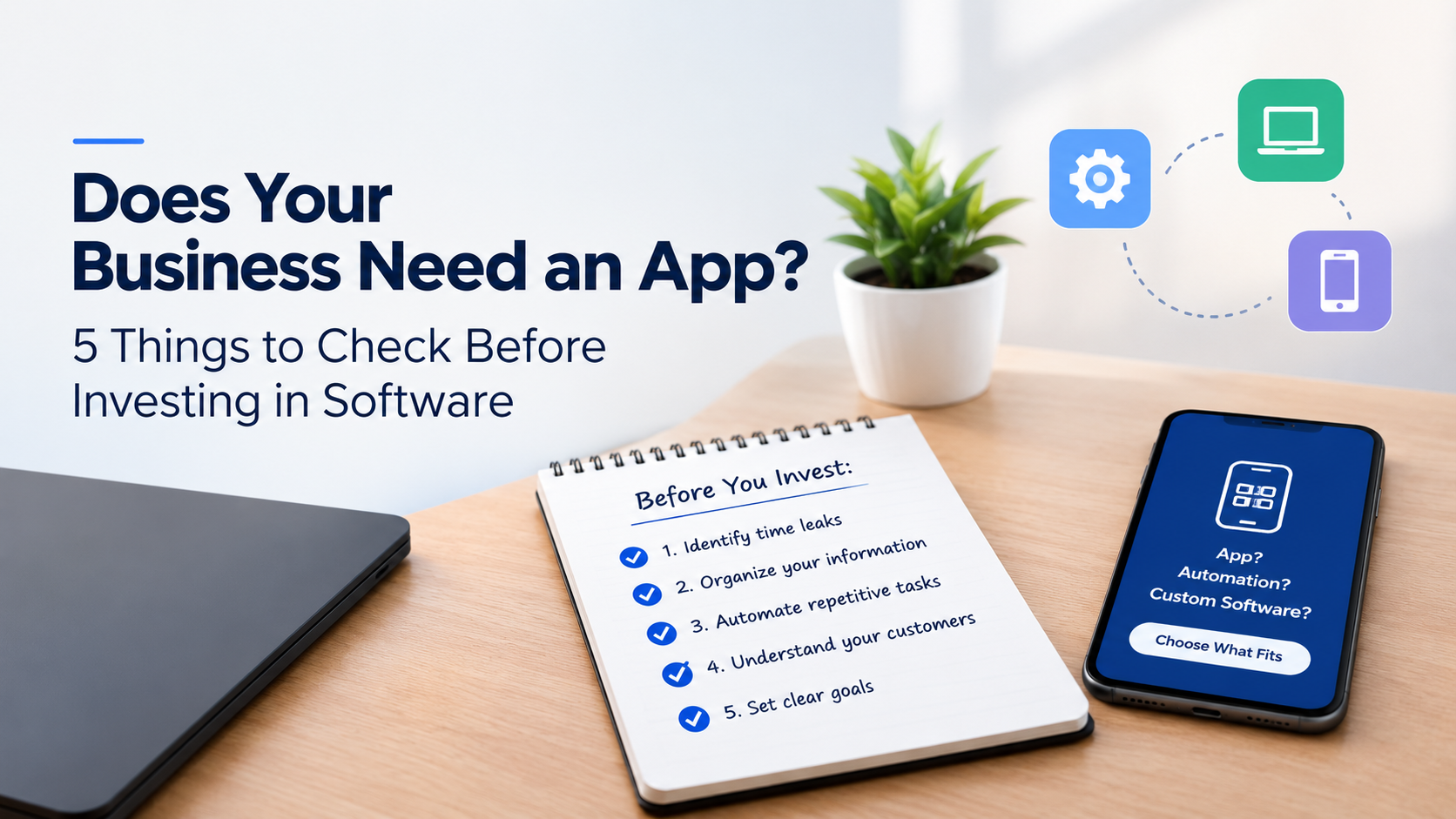
Many business owners believe that building a mobile app or investing in custom software is the next step toward business growth. While technology can improve efficiency, increase sales, and simplify operations, not every business needs a new app to solve its problems.
You may be dealing with scattered customer records, repetitive administrative tasks, missed sales follow-ups, or slow reporting. In many cases, the real solution is better workflow automation or business management software—not necessarily a mobile app.
Before investing in business software development, here are five things to consider.
Are employees spending hours preparing reports, updating spreadsheets, or entering the same information repeatedly?
These inefficiencies can slow down operations and increase costs.
Review your daily business processes to identify unnecessary steps, delays, and repetitive tasks. Once you understand the problem, you can determine whether automation, a business dashboard, or custom software would improve productivity.
Storing business information across notebooks, spreadsheets, WhatsApp conversations, and employees' phones makes it difficult to track important details.
You may struggle to monitor outstanding payments, customer inquiries, inventory levels, or monthly revenue.
A centralized business management system can organize this information and make reporting easier. Depending on your needs, you might require customer relationship management (CRM) software, inventory management tools, accounting software, or a custom solution.
Business process automation helps reduce manual work, minimize errors, and free employees to focus on more important responsibilities.
Common tasks that can be automated include:
Generating invoices and receipts.
Sending payment and appointment reminders.
Tracking customer inquiries and sales leads.
Updating records after payments.
Preparing business reports.
Following up with potential customers.
Start with tasks that are repetitive, time-consuming, and easy to standardize.
Your technology investment should improve the customer experience.
Do customers struggle to place orders, book appointments, make payments, or track deliveries? Do they frequently contact your staff for information they should be able to access easily?
Solutions such as customer portals, mobile-friendly websites, online booking systems, and automated notifications can address these problems.
A mobile app may be worthwhile if customers need its features regularly. Otherwise, a website or simpler automated system may be more practical.
Before hiring a software developer, establish clear business goals.
For example, you may want to:
Reduce administrative workload.
Improve sales conversion rates.
Minimize payment and inventory errors.
Generate reports faster.
Improve customer service.
Process more orders without increasing staff workload.
Instead of saying, "We need software to manage our business," define a measurable objective, such as reducing monthly report preparation from two days to a few hours.
Clear goals help you choose the right solution and measure your return on investment.
The right solution depends on your specific business challenges.
| Business challenge | Possible solution |
|---|---|
| Missed sales opportunities | CRM software and automated follow-ups |
| Inaccurate stock records | Inventory management software |
| Repetitive administrative work | Workflow automation |
| Poor performance tracking | Business dashboard |
| Customers need access to their orders | Customer portal |
| Disconnected business tools | API integration |
| Unique business requirements | Custom software development |
| Customers need frequent app-specific features | Mobile application |
Sometimes, connecting existing tools or improving current processes is more cost-effective than building a completely new application.
Imagine a business that receives customer inquiries through WhatsApp, prepares quotations manually, tracks payments in spreadsheets, and compiles sales reports from different sources.
The owner may think a mobile app is necessary.
However, the business might benefit more from a system that centralizes customer inquiries, assigns leads to employees, tracks quotations and payments, sends follow-up reminders, and generates sales reports automatically.
This approach addresses the actual business problems without the unnecessary cost of building a customer-facing app.
Custom software development is worth considering when existing solutions cannot adequately support your business processes, integrations, or operational requirements.
However, consider the full cost of ownership, including development, hosting, maintenance, security, employee training, and future upgrades.
Start with your most pressing business problem, prioritize essential features, and expand the system as your needs grow.
Business software can improve productivity, reduce manual work, strengthen customer service, and support better decision-making. But success depends on choosing technology that solves a real problem.
Before investing in a mobile app or custom business software, assess your workflows, organize your information, identify tasks to automate, and define measurable goals.
At Dkingstech, the focus is on developing custom software solutions that help businesses automate manual processes, connect disconnected systems, and operate more efficiently.
Is your business ready for automation? Identify the process slowing you down and explore the right technology to improve it.

We'll reach out to you by email soon.