
Company Name vs Brand vs Product vs Domain Explained
24 Oct, 2026
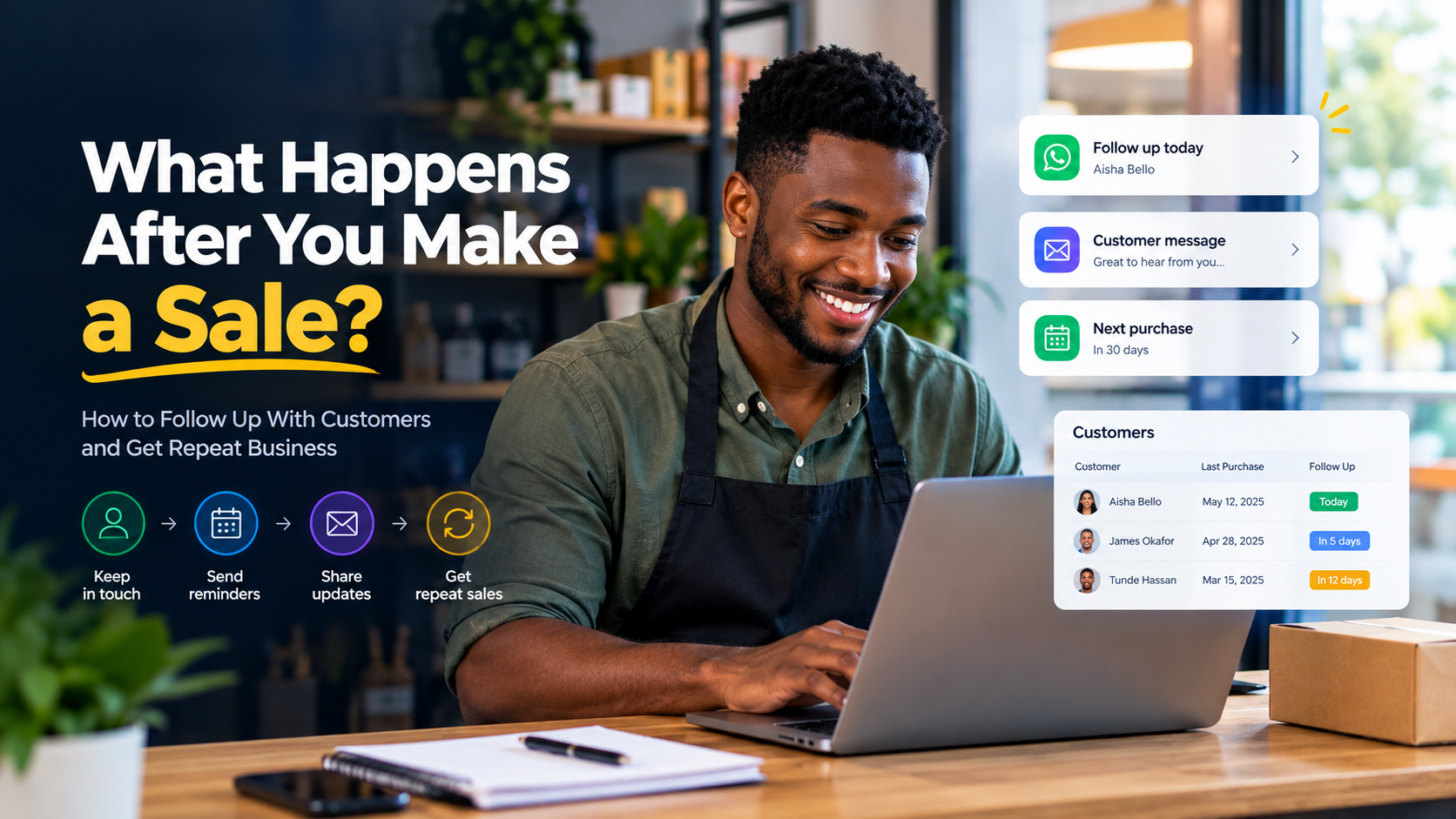
Getting a customer to buy from your business for the first time is important.
But what happens after that?
Do you simply wait for the customer to come back when they need you again? Do you send a message after the purchase? Do you keep their information somewhere? Do you know when it makes sense to contact them again?
Or does the customer simply disappear into your WhatsApp chats, phone contacts, notebook, or spreadsheet?
This is where customer follow-up becomes important.
Many businesses spend a lot of time trying to find new customers while doing very little with the customers they have already earned. Yet a previous customer already knows your business, has already experienced your product or service, and has already trusted you enough to buy.
The question is not only:
“How do I get more customers?”
It is also:
“What am I doing with the customers I already have?”
Customer follow-up is simply the process of staying in touch with a customer after an interaction, purchase, enquiry, appointment, or completed service.
It could be as simple as:
Checking whether a customer is satisfied with a purchase
Asking whether they need anything else
Reminding them when they may need your product or service again
Informing previous customers about something relevant
Following up on an enquiry that did not result in a sale
Asking an existing customer for a review or referral
Reconnecting with customers who have not bought from you in a while
It does not always have to be complicated.
The important thing is that the relationship does not end simply because the payment has been made.
Imagine two businesses.
Business A gets a customer, completes the sale and never contacts that customer again.
Business B gets the same type of customer, keeps a simple record of the purchase, checks in when appropriate and contacts the customer again when there is something genuinely useful to offer.
Business B has created another opportunity to do business with someone who already knows them.
That is the basic idea behind customer retention.
Customer retention is not about constantly sending customers promotions or disturbing them with messages. It is about giving people a good reason to continue doing business with you.
A recent search landscape around small-business growth shows the same recurring advice: keep useful customer records, follow up at an appropriate time, and make it easy for previous customers to return.
There is no single follow-up process that works for every business, but a simple starting point looks like this.
You cannot effectively follow up with a customer you cannot identify or reach.
At a minimum, you may want to keep:
Customer name
Phone number or email
What they purchased
Purchase date
Relevant order information
When a follow-up may be appropriate
For a small business, this could start with a simple spreadsheet.
The important thing is not whether you use a spreadsheet, notebook, or software.
The important thing is that the information is organized and useful.
A follow-up does not always need to be a sales message.
Sometimes, the best thing you can do is simply ask:
“How is the product working for you?”
Or:
“Just checking in to make sure everything went well with your order.”
This gives the customer an opportunity to tell you if there is a problem.
It also keeps your business in their mind.
The right follow-up time depends on what you sell.
If you sell a product that customers may replace every month, following up after several months may be too late.
If you provide a service that customers may need once or twice a year, messaging them every week would make little sense.
The goal is not to contact customers as often as possible.
The goal is to contact them when there is a good reason to do so.
A customer may have had a good experience and still not return simply because they forgot about your business.
You can give them a useful reason to reconnect.
For example:
A product they previously bought is available again
A related product has been launched
It is time to reorder
You are offering something relevant to their previous purchase
They may need another service
You have useful information that applies to them
The follow-up should make sense from the customer's point of view.
This is where many businesses get it wrong.
Following up does not mean sending:
“Hello dear, buy from us today!”
every few days.
If every message is asking for money, customers will eventually ignore your messages.
Instead, make your communication useful and relevant.
For example, instead of sending every customer the same promotion, you could group customers according to what they bought and contact them when you have something relevant to them.
A customer who bought a particular product six months ago may be interested in a related product.
A customer who completed a service may need another service later.
A customer who made an enquiry but never purchased may simply need a reminder.
Good follow-up is about timing, relevance and consistency.
At the beginning of a business, manually following up may be manageable.
You might remember your customers.
You might have their numbers saved in your phone.
You might keep a spreadsheet.
But as the number of customers grows, things become harder.
You may start asking:
Who bought from us last month?
Who needs a follow-up today?
Who asked for a quotation but never responded?
Which customers have not bought from us in a while?
Who should receive this new product announcement?
Did someone already contact this customer?
When should I contact this customer again?
Eventually, the problem is no longer getting customer information.
The problem is remembering what to do with it.
Yes.
A customer follow-up system can help a business organize customer information and remind the team when action is needed.
For example:
Customer makes a purchase
↓
Customer information is saved
↓
Purchase is recorded
↓
System sets a follow-up date
↓
Business receives a reminder
↓
Follow-up message is sent
↓
Customer response is recorded
The system does not have to replace the person.
It simply makes it harder for important follow-ups to be forgotten.
This is particularly useful for businesses that currently depend heavily on WhatsApp chats, spreadsheets, paper records, or someone's memory.
A simple customer management system could help a business:
Store customer information
Record purchases
Track enquiries
Record previous conversations
Set follow-up reminders
Track pending follow-ups
Group customers
Send or prepare follow-up messages
Track customer responses
Identify customers who have not returned
Keep sales and customer information together
The exact features should depend on the business.
A furniture company does not necessarily need the same system as a school, logistics company, retailer, or professional service business.
The goal is not to buy complicated software.
The goal is to solve the problem that is costing the business opportunities.
If you are a small business owner and you currently have no customer follow-up process, don't start by trying to build a huge system.
Start simple.
Know who your customers are.
Know what they bought.
Know when you should contact them.
Know what you should say.
Then make sure someone actually does it.
You could start with a simple spreadsheet and reminders.
As the business grows, you can move to a proper customer management system that handles more of the process automatically.
The technology should follow the business process — not the other way around.
The first sale proves that someone was willing to trust your business.
But the relationship should not necessarily end there.
A business that consistently gets new customers but loses contact with previous customers may spend all its energy starting from zero.
A better approach is to build a process that handles both:
Get new customers.
Take care of the customers you already have.
Make it easy for them to come back.
That is where customer follow-up, customer retention and simple business automation can make a real difference.
Your next sale may not require finding a completely new customer.
It may already be sitting in the list of people who have bought from you before.
The next time you make a sale, don't only ask:
“How much did we make?”
Also ask:
“What happens next?”
If you don't have an answer, that may be one of the first business processes worth improving.

We'll reach out to you by email soon.
